
Why you'll keep making the same trading mistakes (and why being good at your job could be making it worse)
Category: Trading psychology | Read time: 8 minutes | Author: Ali Crooks
Most aspiring traders know that their own greed or fear-based trading tendencies will be causing an issue with their trading.The thing most traders have not properly thought through is how the two issues don't just show up differently in the market. It's how they can be the catalyst to self sabotage but in completely different ways, at completely different times, for completely different reasons.
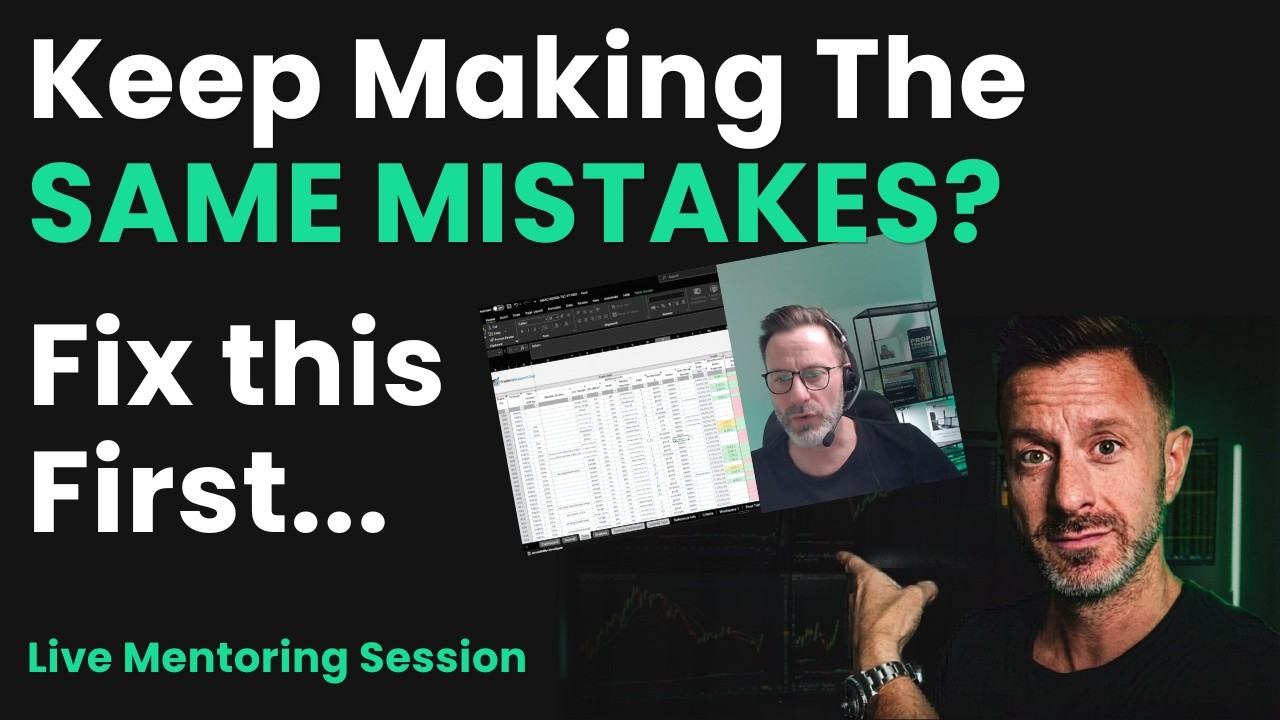
The video above is from one of my coaching sessions with my client Andrew. He is a DJ by trade and hobby and an aspirational trader who's got serious intentions of going full-time. We get into exactly why he keeps making the same trading mistakes and why a specific skill that makes him exceptional in his DJing is what is quietly working against him in the market. Then we focus very specifically on the actions he can take so that things can be different from this point forward. If you've ever looked back at your trades and thought "Why do I keep doing this?", this live session recording is for you.
The pendulum most traders don't know they're on
One of the first things I walked Andrew through was what I call the results pendulum.
Most traders believe that the ideal short-term trading run is ten winners in a row.And yes, for your P&L, that's fantastic. But for your psychology, it's often one of the most dangerous places you can be.
Here's why.
When your results swing too far in either direction, with too many winners or too many losers, your emotions nearly always end up taking over. The further that you move away from what I call the optimum trade distribution (something like winner, loser, winner, winner, loser, winner, which is far more optimal), the more vulnerable you become to making decisions based on your feelings rather than your process. That's when your trading becomes emotional trading, often in the most subtle of ways, but this type of emotional trading can be insidious and very difficult to overcome.
Now here's the bit that most people miss, and it's the thing Andrew and I spent a good chunk of time on.
Andrew's average reward to risk ratio trading result, looking at his data from this year, is four to one. So you'd think, knowing this, he would be relaxed about his losing trades. But he's not. He's pressing buy or sell when he shouldn't be because, emotionally, a losing trade to him still feels like a problem that needs to be solved.
When I pointed out to him that someone with a 4:1 average R value should actually be welcoming their losers, because the sooner they get them out of the way, the closer they are to their next winning run, it landed. But knowing this and feeling this in the moment are two very different things. That's the exact gap that we are there to close.
Future pacing your trading: the skill that helps you in so many areas of your life, except this one
This is the part of the session I find myself coming back to, because it's one of the most honest things I've seen in a long time in a trading psychology coaching conversation.
Future pacing trading, imagining a positive outcome before it happens, is something Andrew does brilliantly as a DJ. He builds a playlist in his head before he walks into the venue. He thinks ahead. He plans for the room. And when the crowd shifts, he shifts with it. That skill is a huge part of what makes him good at his job.
But in trading, it's quietly wrecking him.
Here's what happens. Andrew has a good run of trades. His results pendulum swings into winning territory. And almost immediately, without consciously deciding to, he starts future pacing. He's not thinking about the next trade in front of him.He's thinking about what those profits mean. What happens if this keeps going.What the account looks like at the end of the week.
He's not even doing it deliberately. The thought bypasses conscious reasoning entirely and lands straight in the emotional system. By the time he's aware of it, the greed is already running.
And this is what I mean when I say being good at your job can work against you as a trader.
Future pacing is a skill. You've been rewarded for it in other areas of your life, probably for years. So when the market gives you a good run, your brain does exactly what it's been trained to do. It projects forward. It gets excited about what could come next. And in trading, that's often when the wheels come off.
The same thing happens in the opposite direction. Bad run, losses mounting, and the brain starts future pacing a way out. How do I get back to break even? What trade gets me out of this hole? It's the same mechanism, just pointed in the other direction.
Greed vs fear: which type are you?
This matters, but also understanding what triggers this and how your personality style affects this is important as well. That's for another blog post.
In short, Andrew is greed-based, and there is a lot right about that, it's what makes him willing to take the trades in the first place. This is something that most fear-based traders simply can't do. But his greed-based tendencies mean that when things are going well, he switches off and loses that element of vigilance that helps to keep him on track.
For you, the moment you think "I've stuck to my trading rules"and you start feeling too good about it, that's exactly when you are most susceptible to breaking trading rules.
In most cases, a fear-based trader works in the opposite way. Rather than"How can this trade make things better?", they consciously or unconsciously ask themselves, "How will this trade make things worse?" Different problem, different solution.
If you're not sure which camp you're in, look at when you make most of your trading mistakes. Do they tend to happen when things are going well and you start stretching, which could be being lenient with your risk size or trying to run trades for longer? Or when things aren't going well, do you again increase your risk or overtrade to make the losses back? Or when things are going well, do you automatically think the next trade will be a loser and get scared to push the button? Or when things aren't working out and going wrong, you freeze and then afterwards wish you had taken the next trade? Knowing what you do and don't do when the pressure is on, both positively and negatively, will tell you a lot about not just whether you are fear or greed orientated but what those triggers do in the moment.
The data that doesn't lie
One of the things that came out very clearly in Andrew's session, and it's something I say to every mentee who works with me, is that you cannot fix what you cannot see.
When I looked at Andrew's data properly, the pattern was right there to see. Yes, he was seeing clear improvements in his trading consistency from where he was when we first started working together. Why? Because the mistake clusters from earlier in his trading records were starting to happen less and less. He was still making mistakes, but they weren't firing off the same chain reactions and the same over-trading tendencies in the same way as they used to.That, to me, is real progress. It's not perfect, and there's still more to do, but this progress, which is critical and I see so many traders not make it, came directly from him tracking his trading data and journalling his behaviour.
For me personally, when I was dealing with my own revenge trading, it was similar to Andrew's but a little bit more subtle. However, the only way I cracked it was by going into the data and noticing the patterns that occurred on a regular basis. Nearly every time I had two losers in a morning session, my trade frequency would spike in the afternoon and I would have a minimum of four trades that day. I couldn't see this in the moment and would have never known if you'd asked me, but the data showed this clearly. Now yes, on some days they were valid trades, but on the majority of times these were subtle rule break trades, with me missing set up elements and front running entries.
In short, that's what tracking trading data and journalling can do for you.It simply makes the invisible visible, and once you can see a pattern, it's hard to not see it. It's then up to you to create a plan around that awareness so it doesn't keep happening.
Creating a pattern break trading move
The last thing Andrew and I talked about was what to actually do in the moment. Understanding your psychology is one thing, having a practical move or action you can take when that trigger shows up is another.
You're not trying to stop the feeling coming up. The feeling will always show up because it's natural as a human being and it's been wired into you over years of not just trading but other scenarios similar in your life. Your job is to just interrupt the chain between the feeling and the action. This is the practical starting point to stop breaking your trading rules, not by willing yourself to be more disciplined, as no trader wakes up in the morning thinking to themselves "Today is the day I'm not going to be disciplined." What you do is, over time, engineer a different response between the feeling and the action, right in what we call the gap.
Andrew is also doing the deeper work through meditation and building metacognitive awareness, which simply means being able to observe his own thoughts before he acts on them. This helps to turn down the volume on the feeling without ignoring it entirely. Doing this over and over again is the long game, but each time he's successful, he breaks the pattern break trading cycle in the short term.
What this means for your trading discipline
If you've read this far and you can relate to anything that I've said, then I'm sure at some point trading discipline has been an issue or you might still be struggling with this right now. My hope is that, if nothing else, this is just being a confirmation that this stuff you are challenged with is not unique to you. Every trader I've ever worked with, and at this point that's hundreds of people over the last 20 years, has some version of this running in the background. The question is not whether it's there, it's whether you've got the right framework to identify it and the right tools to interrupt it and overcome it.
If you want to go deeper on the psychology side, the four pillars of trading framework that sits behind everything I teach puts Psychology & Emotions as one of four core pillars, not an add-on, not a nice-to-have. It's as fundamental as your strategy.
If you want to see where you currently stand across all four pillars, the TSC Trader Diagnostic is the place to start. It's free, it takes about ten minutes, and it gives you a genuinely useful breakdown of where your trading psychology process is strongest and where the quiet leaks are hiding.
Take the free Trader Diagnostic here
If you're already past that point and you want the kind of session Andrew had, going properly into your data, your patterns, and building a real plan around them, then Mentorship 2.0 is what that looks like.
Find out more and apply for Mentorship 2.0 here
And if this video helped, do me a favour and watch it to the end if you haven't already. The specific action steps I give Andrew at the close of the session are the practical piece that ties everything together.
Trade safe,
Ali
Ali Crooks is an FCA-regulated money manager and founder of Traders Support Club,one of the UK's longest-established retail trader education businesses. He has been trading his own funds since 2004 and coaching traders since 2007.
Alright… Not one of the most exciting subjects we have ever covered, but definitely one of the MOST important.
Risk management is something so many traders “think” they have locked down, but actually what they are doing is taking themselves down a road of no return.
Both for them and their account balance.
And what’s worse…
There is a group that simply overlooks risk altogether, or takes some one-time advice that is usually completely inappropriate for them and the way they trade!
So how do you make sure you not only know what to do when it comes to risk management, but you ACTUALLY do it?
First Off…Know Your Numbers
Yes, it’s a small bit of maths, but knowing the simple multiples can save your account balance!
Let’s say you are risking 10% of your cash pot per trade.
But that only requires a 5 trade-losing run to be the best part of 50% down overall.
Oh well, I still have half my money.
Hang on!
You now need a 100% return on that balance JUST to get back to where you were 5 short trades ago.
Let that sink in for a second…

Want To Achieve Long Term Consistency Regardless Of Market Conditions
& Your Current Experience...
Find out more about our complete trader training system...